“Waiting for Godot” Disrupts Expectations & Wows! —at Los Altos
Millennial Notes
Samuel Beckett Explores Friendship vs. Domination
by Hamilton Nguyen
Samuel Beckett’s “Waiting for Godot” offers a unique and haunting exploration of the human condition. The post-WWII classic departs from traditional plays, abandoning climax and resolution. Beckett focuses instead on friendship, domination, and the threatening passage of time.
Nobel Prize winner, Irish poet, playwright, and novelist Beckett shows how humans are always tied to nature, time, and people. He uses two aimless bums to illustrate friendship. And then, a master slave duo to expose the toxic nature of authority. Beckett takes us on an emotional roller-coaster, moving from lethargy to mania.
Director Gary Landis effectively captures Beckett’s absurdist vision with wonderful casting and direction. “Godot” must be experienced emotionally because words alone are insufficient.
In his two brief appearances as the messenger Boy, inspiring James Rose expresses so much with his “Yes, sir” & “No, sir.” He channels confidence, doubt and fear. Wonderful work from the young actor.
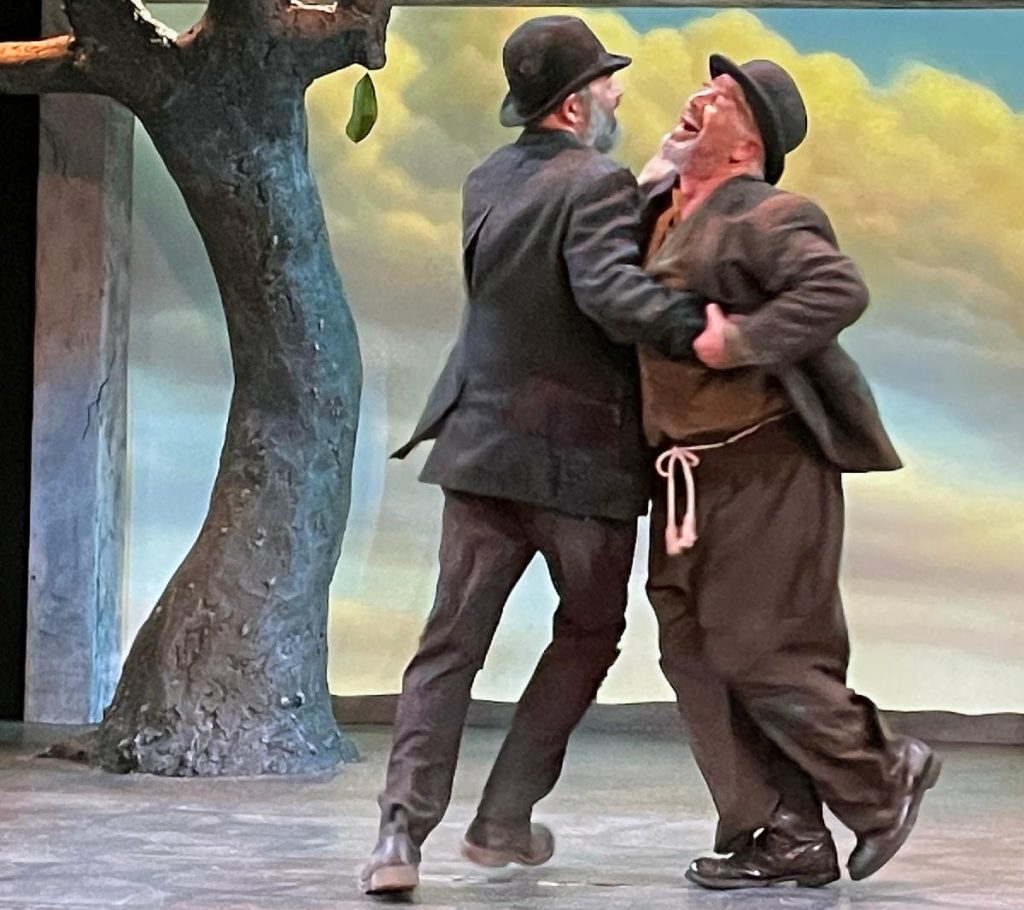
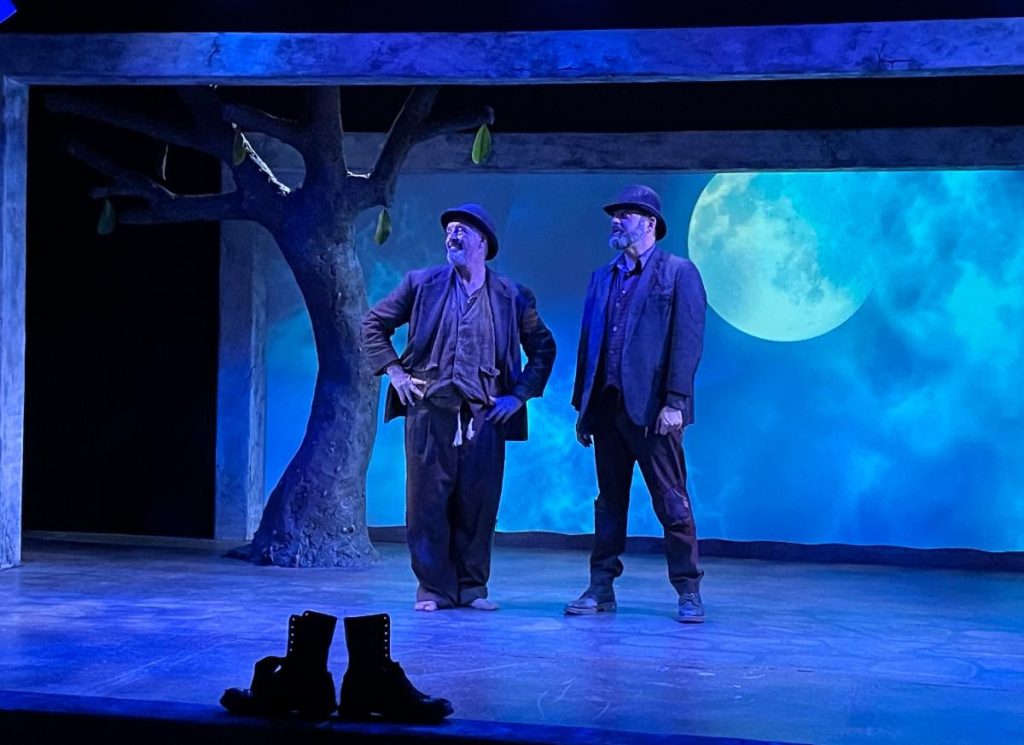
As the unpredictable Estragon, infinitely energetic David Scott generates concern and edginess. Dressed in a muddied, brown suit, Estragon babbles and paces restlessly, inducing anxiety in us, as he contemplates suicide. At one moment, Estragon calmly checks his battered boots for pebbles; and at another he passionately throws himself on the rocks.
Scott’s mesmerizing Estragon captures the birth of modern anxiety during and after the World Wars. His anguish stems from being a survivor in a post-apocalyptic, deserted, and dangerous world. It’s the end of history and of civilization.
Unlike his buddy, Vladimir, the elegant Evan Winet, provides support and compassion to his friend. Whether Vladimir is gathering scraps of vegetables for his friend, or foiling his suicidal plans, Vladimir offers boundless love. His presence in a deep blue suit reminds us of calming waters.
As Vladimir, Winet’s energy and empathy shine brightly. The impoverished buddies are homeless and hungry. But they hold onto a precious jewel in this chaos—friendship. Beckett shows us that friendship is a choice.
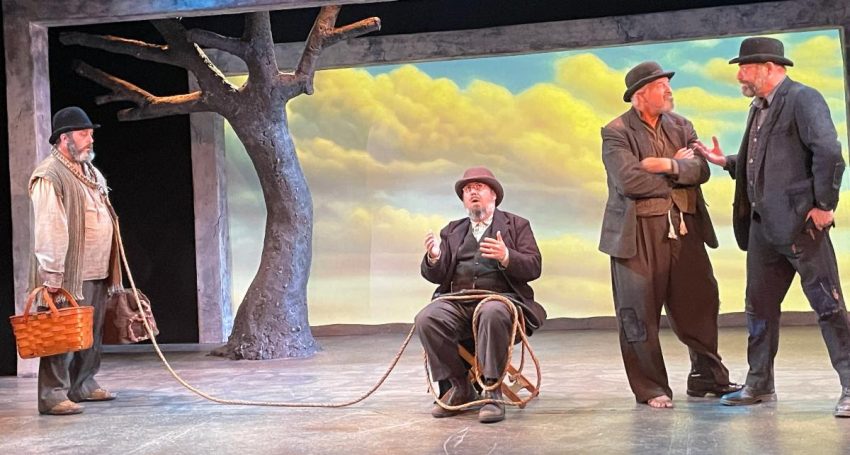
Then Beckett brings on two wild characters who contrast to Estragon and Valdimir. Enter a master and slave pair–one leading the other by a rope. Brash, sharply dressed Pozzo (commanding John Stephen King) bursts in, a comic character evoking the rich and powerful. Pozzo drives his slave forward, shouting orders.
Pozzo’s domineering strategy isolates him from human connection. Beckett warns us that unlimited wealth leads to disaster.
Wearing a weathered burlap sack, Pozzo’s worker, Lucky (intense Marc Berman), carries his boss’s burdens. Graced with a moment of freedom, Lucky speaks his mind, eloquently and poetically, but nothing changes. The gravity and futility of Lucky’s speech leave him mute.
“Godot” is an acquired taste. The more I dwell on it, the more disturbed I become. Time marches on, whether we are thinking about life or doing life. “Godot” waits for no one and watching “Godot” expresses the futility of life’s options.
As Estragon ponders, “All are born mad, some remain so.”
“Waiting for Godot” by Samuel Beckett, directed & produced by Gary Landis, costumes by Lisa Rozman, lighting by Aya Matsutomo, at Los Altos Stage Company. Info: LosAltosStage.org – to September 29, 2024.
Cast: David Scott, Evan Winet, John Stephen King, Marc Berman, Kuba Adams, and James Rose.